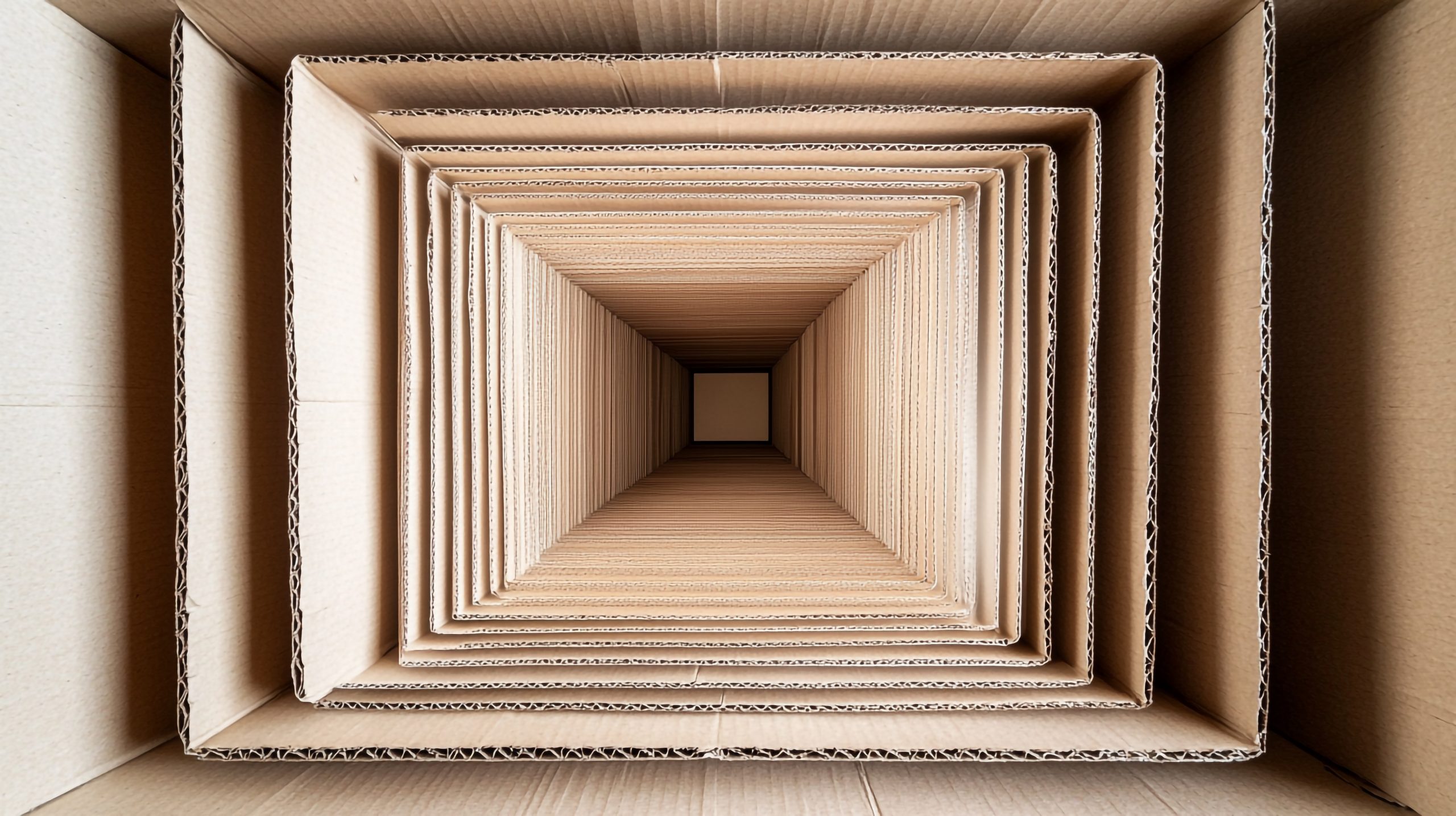
Wrong packaging is making you overpay for shipping.
A bottle of onion oil does not need a box as big as a juicer, but you are doing it anyway.
An optical mouse does not need a box as big as an SMPS, but it’s happening anyway.
Large packages mean large dimensions. Large dimensions mean high dimensional weight.
The result? High shipping costs.
But you have a simple solution: nesting.
What is nesting in shipping? It is arranging products so they fit inside one another. Think of it like stacking bowls or cups to reduce volume and dimensional weight.
Forceget Supply Chain defines it as a “method of arranging products so they fit together snugly.”
Paccurate describes it as a method of packing small items inside larger ones to save space.
Elicit Technology gives a more technical definition: packing smaller cargo units into bigger ones to improve transport efficiency.
Different words, same definition, same result: saving money.
Why Packaging Is Costing You More Than You Think
Ignoring the Package Size Despite the Stats
A user posted on the r/EgregiousPackaging subreddit. The post pointed at an image: a small cellophane packet of nails inside a massively oversized box fit to hold a TV. The caption read: “Probably could have used a narrower box.”
If there was no image, the text would’ve felt like a hyperbole.
Boxes are getting too big too often, and sellers are ignoring them despite what the stats say.
According to a Forbes Insights & DS Smith report, 60% of executives say that more than 25% of their packaging spend is on empty space.
An oversized package can cost 30 to 50% more than expected.
For a single shipment, the size discrepancy is tolerable. Repeated across hundreds or thousands of shipments, the annual overpayment adds up.
Most packages are lightweight. An average eCommerce package is only 1 to 3 pounds, measures only 18″ x 16″ x 6″. But the dimensional weight jacks up the shipping cost.
The solution seems simple: make small packages. So why do sellers ignore it?
Why did a user named starlightskater sarcastically thank Amazon for receiving four small bags of gummies in four separate boxes?
Introduction of DIM Weight Ramped Up Packaging Costs
Dimensional weight was not an issue before 2015.
Brands unconsciously picked what worked.
Is the deadline approaching for the delivery? Pick whatever package is available.
Size did not matter, on time delivery did. That line of thought formed a habit that brands have a hard time letting go of.
After 2015, carriers came with DIM weight pricing to account for space the packages occupy, not just the weight.
It meant that a lightweight but bulky package could cost more.
The same brands still used the same old oversized packages.
For example, a 3 pound box of pillows measuring 24x18x12 inches could be billed at approximately 37 pounds due to dimensional weight pricing.
“Even a ¼ inch can cause packages to get billed at higher weights than expected.” says Sean Kim, VP of Parcel at Kase.
eCommerce shipping now costs $8 to $15 per order on average.
30 to 40% of the cost is buried inside dimensional penalties, returns, and other inefficiencies.
Nesting: The Easiest Fix for Sellers that Never Try
Kase found that when Hiyo’s most ordered SKU was driving up the costs, it redesigned the shipping box.
Fulfillment costs dropped by 30%.
Redesigning a box has its own cost. Since cost is still the ruling narrative, sellers attach packaging and “high costs” too closely together.
This psychology makes them apprehensive even when cost savings through packaging optimization is the topic.
One seller said on the eBay community forum, “$127,500/year in wasted costs really hit me.” In such situations, nesting could have cut the waste early.
Fitting a package inside another can reduce per shipment costs by 15 to 30%.
What Does Nesting Mean in Packaging?
Simple Definition
Nesting is defined as the act of fitting products inside one another to minimize total box size and dimensional weight.
In logistics terms, it means placing smaller cargo units inside bigger ones, or stacking items of similar shape and contour into each other.
An example of a product with this capability would be garbage cans. By stacking them inside one another, the overall container space needed is reduced.
Nesting vs. Regular Packing
Here’s a table drawing distinction between nesting and regular packing:
| Regular Packing | Nested Packing | |
| How it works | Each item placed side-by-side with void fill between them | Items fitted inside one another, stacked by shape |
| Example: 4 mixing bowls | Each bowl sits flat next to the other, separated by bubble wrap | Bowls stacked inside each other with a single layer of protective wrap |
| Estimated box size | 30 x 30 x 30 cm | 20 x 20 x 15 cm |
| Box volume | 27,000 cm³ | 6,000 cm³ |
| DIM weight (Canada Post, ÷6000) | 4.5 kg | 1.0 kg |
| Estimated void space | 50-64% | 10-15% |
| Void fill needed | Heavy (bubble wrap, air pillows, paper) | Minimal (thin wrap between items) |
| Packaging material cost | Higher (more filler, larger box) | Lower (smaller box, less filler) |
| Shipping cost (Toronto → Vancouver) | ~$18.40 | ~$11.20 |
Real-World Example
Here’s a real-world example of sellers saving money through nested shipping.
A Toronto Shopify seller found that the box size was costing too much. Upon inspection, they found that the extra size was impractical.
They redesigned the box, reducing its size by 40%.
Result? $3.20 per shipment in savings.
When compounded over 500 orders per month, it meant $1,600 in savings per month.
Why Nesting Matters for Canadian eCommerce Sellers
Dimensional Weight Explained
Dimensional weight is the silent cost most Canadian sellers underestimate.
It does not show up as a separate line item. It hides inside the shipping rate, inflating the bill based on how much space a package occupies rather than how much it weighs.
Every major carrier in Canada uses it.
Canada Post calculates DIM weight using the formula: Length × Width × Height (in cm) ÷ 6,000. They compare this number against the actual weight of the package and charge whichever is higher.
A light package in a large box will almost always be billed at the DIM rate.
Purolator takes a slightly different approach. They convert package dimensions to cubic feet (L × W × H ÷ 1,728 in inches) and multiply by a cube factor:
- ×15 for Express (air)
- ×12.4 for Ground.
Packages over 50 lbs or with a longest side exceeding 48 inches trigger an Oversized surcharge of $27.60 per piece. The calculation is more layered, but the outcome is the same. Oversized packaging costs more.
Canpar follows a similar DIM weight structure. Where it gets expensive is the additional handling surcharges. Packages that cannot be processed on automated conveyor systems attract extra fees.
Odd shapes, bulky dimensions, anything that needs manual processing gets penalized.
eShipper notes that most couriers in Canada, including Canada Post, use a DIM divisor between 5,000 and 6,000.
UPS Canada and FedEx Canada both use a divisor of 139 (in inches) for standard daily and retail rates. The lower the divisor, the higher the DIM weight, and the more you pay.
Here is what that looks like in practice.
A lightweight scarf weighing 200g ships in a 30 × 30 × 20 cm box. The DIM weight calculation: 30 × 30 × 20 ÷ 6,000 = 3 kg. The scarf weighs next to nothing. The seller pays for 3 kg.
That is 15 times the actual weight.
Nesting attacks this problem directly. Fit that scarf inside a bundled order or reduce the box to match the product’s actual footprint. The DIM weight drops with it.
Canada’s Shipping Zones Make It Worse
Canada Post divides its shipping routes into zones based on distance.
Zone 1 covers local and same-province deliveries.
Zone 6 reaches remote territories. Rates climb at every step between.
The zone classification follows a regional and national split. Regional shipments move within the same region: Vancouver to Winnipeg, for example. National shipments cross regions entirely: Vancouver to Halifax.
The farther a package travels, the more it costs in fuel, routing, and handling. Canada Post applies this distance-based pricing to every parcel, and the rate difference between Zone 1 and Zone 5 or 6 is significant.
Long-haul routes hurt the most. A shipment from Toronto to Vancouver is a coast-to-coast national route that spans multiple zones. Each zone crossed adds to the base cost.
RoadLinx confirms that east-to-west shipments carry the largest price jumps due to longer routes and regional zoning.
Zone-based pricing multiplies the cost of bad packaging. A package billed at a higher DIM weight does not just pay more once. It pays more at every zone it crosses. An oversized box shipping locally might absorb the penalty. That same box crossing four or five zones turns a small packaging mistake into a compounding cost problem.
Nesting does not eliminate zone-based pricing. What it can do is reduce the weight that gets multiplied across those zones.
A smaller DIM weight moving across the same distance pays less at every step.
Cross-Border Impact
The US de minimis exemption is gone.
As of 2026, the $800 duty-free threshold is fully suspended. Every commercial parcel shipped from Canada to the US now faces customs assessment, duties, and additional fees regardless of value.
The impact is already showing.
SAL Accounting documented a Mississauga-based Shopify beauty brand that shipped to the US using Canada Post. The results: frequent customs holds, surprise duties at the buyer’s doorstep, and a 25% return rate driven by unhappy customers who did not expect the extra charges.
Smaller, optimized packages do not remove duties, but they reduce the base shipping cost that duties and surcharges stack on top of.
Mississauga and Brampton sit at the center of this. The two cities are among the largest ecommerce shipping hubs in the Greater Toronto Area for cross-border fulfillment.
Sellers operating from this corridor ship high volumes to US destinations daily through USPS, UPS, and FedEx.
The cost trajectory is not slowing down. Statistics Canada data, cited by eShipper, shows that average domestic parcel shipping costs have increased by at least 9% since 2021.
Fuel surcharges, inflation, and rising demand for faster delivery all contribute. Cross-border shipments cost 30 to 50% more than domestic ones. A 2 lb package shipped from New York to Toronto starts at $30 to $35 with FedEx Ground alone.
Long-term regulatory solutions exist. The USMCA trade deal allows many products to cross the border duty-free with the right paperwork. But trade agreements take time, and do not address the base cost of shipping an oversized package.
Nesting is something a seller can implement today. A smaller box, a lower DIM weight, a reduced shipping bill on the next order.
Top Products Best Suited for Nesting in Canada
Apparel & fashion accessories
Clothing ranks among the lightest ecommerce categories at 0.5 to 1.5 lbs per package.
Switching from boxes to poly mailers with layered garments cuts shipping costs by 15 to 20%.
Fold items into each other inside a single poly mailer. One mailer fits one pair of socks or five without changing the packaging cost.
Kitchenware & containers
Glassware and kitchenware carry the highest empty space rate in ecommerce packaging at 64%, according to DS Smith.
Nesting bowls or cups inside each other can reduce box size by up to 40%.
How to Implement Nesting on Them?
Stack items by shape contour with a thin protective layer between each piece.
Beauty tools & skincare sets
Beauty and skincare products are lightweight but fragile, making them one of the highest return-rate categories due to damage.
Custom-sized packaging with nested product inserts has reduced shipping costs by 20% in documented cases.
How to Implement Nesting on Them?
Place smaller bottles or tools inside kit boxes or layer them in fitted trays to eliminate dead space.
Small electronics & accessories
Electronics range from 2 to 10 lbs per package, but accessories like cables, cases, and chargers are far lighter.
Nesting accessories inside the primary product’s box removes the need for a second package entirely.
How to Implement Nesting on Them?
Amazon’s Frustration-Free Packaging follows this principle: shipping items in their original packaging with no added box.
Home décor items
Home décor has some of the most variable dimensions in ecommerce, making standard box sizes a poor fit.
Nesting decorative bowls, vases, or candle holders inside one another reduces both volume and the need for heavy void fill.
How to Implement Nesting on Them?
Wrap nested items in a single layer of molded pulp or tissue to protect finishes without inflating the box size.
Step-by-Step: How to Nest Your Products Correctly
1. Audit your 5 most-shipped SKUs
Start with the products you ship the most.
Magebit’s research shows that 5 to 10 products typically account for most shipping cost inefficiencies.
Pull recent invoices and review the packaging sizes used for each.
Then measure the actual product dimensions against the box it ships in.
The gap between the two is the wasted space you are paying for.
2. Test smaller box configurations
Once you know where the waste is, test smaller boxes.
Use a dimensional weight calculator to check how each new configuration affects the billed weight before committing.
Different products need different packaging approaches.
Apparel and non-fragile items can shift to poly mailers, which eliminate box dimensions entirely.
Fragile but lightweight items benefit from bubble mailers with built-in cushioning, removing the need for additional void fill inside a larger box.
3. Measure dimensional weight before and after
Dimensional weight shipping in Canada varies by carrier, but the tools to calculate it are free and accessible.
ShippingChimp’s shipping cost calculator compares DIM weight across carriers.
Canada Post’s Find a Rate tool and eShipper’s rate calculator offer carrier-specific estimates.
MagicLogic recommends calculating DIM weight during load planning, before packing, not after.
Measure the old configuration. Measure the nested one. The difference is your savings per shipment.
4. Update packaging guidelines for your warehouse
Packaging optimization in Canada starts with standardization.
Once you have the right dimensions for your top SKUs, lock them into a narrow set of box sizes and mailer formats.
This reduces variability, speeds up packing, and keeps DIM weight consistent across orders.
Create digital guides that match each order’s details, including dimensions, fragility, destination, to the correct packaging.
eShipper’s fulfillment team conducts packaging audits to identify cost-saving opportunities like right-sizing parcel containers.
The same logic applies in-house. Document the rules so every packer follows them.
5. Track cost savings per shipment weekly
The work does not end at implementation.
Track shipping cost as a percentage of revenue. The target range for ecommerce is 5 to 15%.
Monitor average shipping cost per order by carrier.
Review monthly. Spot high-cost patterns, test alternatives, measure results.
Platforms like ShippingChimp, Easyship, and Shopify Analytics offer dashboards that surface these metrics without manual tracking.
Compare Shipping Costs Nested vs. Non-Nested
| Scenario | Box Size | Billed Weight | Estimated Cost |
| Non-Nested (Toronto → Vancouver) | 30x30x30cm | 4.2kg DIM | $18.40 |
| Nested (Toronto → Vancouver) | 20x20x15cm | 1.8kg DIM | $11.20 |
| Savings per shipment | $7.20 🎉 |
Best Packaging Tools for Canadian eCommerce Sellers
Dimensional Weight Calculators
Dimensional weight calculators make decision-making easier.
ShippingChimp’s shipping cost calculator compares DIM weight and rates across multiple carriers in a single view. One input, multiple outputs.
Canada Post’s Find a Rate tool gives carrier-specific estimates using their 6,000 divisor. eShipper, Secureship, Canpar, FedEx Canada, UPS, DHL, and Purolator all offer their own rate calculators for more targeted estimates.
For sellers managing load planning at scale, MagicLogic’s Cube-IQ calculates DIM weight before packing and supports mixed units across inches, centimetres, pounds, and kilograms.
Poly Mailers for Soft Goods
Poly mailers cut shipping costs by 15 to 20% compared to boxes for apparel.
They are lightweight, flexible, and adjust to different volumes without changing the packaging footprint. Shopify recommends poly mailers for non-fragile items like clothing because they eliminate box dimensions from the DIM weight equation entirely.
EcoEnclose offers 100% recycled poly mailers. They are the lightest option available and the cheapest to ship. Accessibility is not a barrier here.
Adjustable Box Cutters for Right-Sizing
On-demand box sizing is one of the most effective methods for reducing DIM weight.
Box-resizing and scoring tools allow warehouses to cut down oversized boxes to match the product inside. No new inventory of smaller boxes needed. Just trim the one you have.
Paccurate defines an On-Demand Packaging System as a system that integrates right-sizing technology to create custom-sized packaging in real time. It removes the guesswork from box selection and automates the fit.
ShippingChimp’s Rate Comparison Dashboard
ShippingChimp offers up to 53% reduced shipping costs compared to national carriers like Canada Post, FedEx, and UPS.
The platform includes auto-generated labels, real-time tracking, and rate comparison across carriers in a single dashboard.
For Shopify sellers, the ShippingChimp Shopify App brings these tools directly into the store backend. Rate comparison, label creation, and shipment tracking without leaving the Shopify admin.
FAQ
What is nesting in shipping?
Nesting is the practice of placing one product inside another during packing to reduce the total volume of the shipment. It works best with products that share compatible shapes. The reduced volume leads to a smaller box, a lower dimensional weight, and a cheaper shipping rate.
Why does nesting matter for Canadian small businesses?
Small businesses absorb shipping costs more directly than large retailers. They rarely have the volume to negotiate deep carrier discounts. Nesting gives them a cost lever that does not depend on shipping volume or carrier relationships. It works on the first shipment the same way it works on the thousandth.
Does nesting help with Canada Post rates?
Canada Post bills based on whichever is greater between actual weight and volumetric equivalent. A nested package with tighter dimensions produces a lower volumetric equivalent. That lower number either becomes the billed weight or brings the DIM calculation close enough to actual weight that the rate drops into a cheaper bracket.
Is nesting relevant for cross-border shipments from Canada to the US?
Cross-border shipments are where nesting pays off the most. International carriers apply stricter DIM divisors, duties now apply to all commercial parcels entering the US, and surcharges stack on top of base rates. A smaller package reduces the base rate that every other fee multiplies against. The savings compound faster on cross-border routes than domestic ones.
What products are best suited for nesting in Canada?
Any product with a shape that allows another item to sit inside it or stack against it without damage. Cylindrical, conical, and bowl-shaped items nest naturally. Flat, foldable items like clothing layer well. Rigid rectangular products with hollow interiors, like storage containers or desk organizers, are strong candidates. The deciding factor is whether nesting the items reduces at least one box dimension meaningfully.
How do I start nesting my packaging?
Pick your highest-volume SKU. Take it out of its current box. Place it inside or alongside the next most common item in a typical order. Measure the combined footprint. If the new arrangement fits in a smaller box, run the DIM weight calculation for both the old and new configurations. The cost difference on that single SKU, multiplied by monthly volume, tells you whether the change is worth standardizing.

- What Is Nesting in Shipping? The Packaging Trick That Saves Canadian Sellers Serious Money - April 1, 2026
- Amazon FBA Canada Fees Explained: Are You Actually Making Money in 2025? - March 20, 2026
- Zone Skipping Explained: How Smart Canadian Sellers Are Cutting Shipping Costs by Up to 40%? - March 18, 2026

