“I want to get some of your collective wisdom” asked a user on r/Shopify, saying that they had set up shipping for their store and noticed that the cheapest option to ship something to Ontario was $23, which they deemed “awfully” expensive.
“Shipping in Canada is ridiculous,” commented one user. “A small population spread out over a huge span of land,” added another. The reasons Shopify owners end up overpaying on shipping are many.
For one, Shopify’s default carrier options aren’t very attractive. Higher rates on low shipping volumes harm small businesses, and since Canada Post discounts aren’t competitive, they don’t get many options.
The problems with Shopify shipping in Canada are visible to many. The solutions, less so.
How to Reduce Shipping Cost for Shopify Store in Canada
There are 9 ways to reduce shipping costs in Canada. All nine share a common core. First, shippers must change how they view profit. Second, they must understand the core elements of shipping. Finally, they must always keep their eyes open to options.
1. Compare Carrier Rates on Every Order
“Which shipping carrier do you send parcels within Canada,” asked throawayboi on r/Shopify, and the response amounted to one sentence: whichever one is the cheapest.
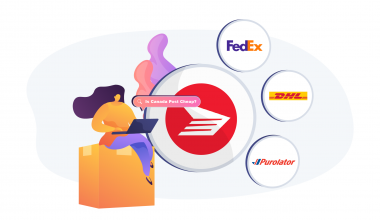
While the idea is right, the results aren’t. Since most Canadian Shopify merchants default to one carrier out of habit, they end up missing rate gaps of $4-$12 per parcel between Canada Post, Purolator, UPS, FedEx, and Canpar on identical routes.
It all happens because they don’t have access to a multi-carrier comparison tool. Without it, they can’t see cheaper alternatives at the moment a label is created.
The best way to use the tool is by running a 30-day audit of past shipments through it to calculate actual overpayment vs. best available rate.
As a result, a merchant saving $5/order across 200 monthly shipments recovers $12,000/year without changing anything else in their operation. Comparing rates also gives you carrier redundancy. If Canada Post disrupts, there is another to complete the fulfillment.
ShippingChimp’s rate starts at $4.64 and curated specifically for d2c businesses. Additionally you can access free pick up and free insurance up to $100.
2. Understand Dimensional Weight
All major Canadian carriers bill on dimensional weight when it exceeds actual weight. It means a lightweight product in an oversized box gets priced as a heavier parcel, and this happens more often than most merchants realise.
Since most merchants never audit whether their box sizes are costing them money, they end up overpaying on every affected shipment.
Dealing with this is straightforward. Calculate the DIM weight for your top-selling SKUs using the standard formula and compare it against actual weight on your carrier invoices.
Then, standardise your packaging to two or three box sizes that cover 80% of orders. Wherever the product allows, use poly mailers instead.
The result: per-shipment cost drops by 15-30% on lightweight or bulky product categories. Material costs fall too, and so do damage rates, which directly reduces reshipping expenses downstream.
3. Use Flat-Rate Shipping
With Shopify, consumers see variable shipping costs as they appear at checkout. The problem is that the sudden reveal of these costs shocks many buyers, making it the leading cause of cart abandonment in Canadian eCommerce.
With flat rates, consumers don’t feel this whiplash. For stores with consistent product weights, flat-rate is almost always cheaper than calculated rates on domestic shipments.
Before setting a flat rate, compare your average shipment weight against Canada Post Flat Rate Box pricing and calculated rates side by side.
After that, set a flat rate in Shopify slightly above your average shipping cost. It builds a buffer for occasional heavier orders.
With it, shipping costs become predictable. Margin planning becomes cleaner as you figure out the true cost-to-deliver before the month closes. Customers encounter fewer surprises at checkout, which speeds up their purchase decision and reduces post-sale shipping complaints.
4. Use Zone Skipping for High-Volume Westbound Shipments
When you ship from Ontario or Quebec to BC and Alberta, you cross multiple carrier zones. Each adds cost. Since Canada is too big and too varied, shipping costs from east to west are disproportionately expensive.
Most small-to-mid Shopify merchants don’t know zone skipping is accessible to them at moderate volumes, which is why westbound shipping continues to feel like a wall.
Deal with this by first identifying whether BC and Alberta together represent 20%+ of monthly orders. If yes, the economics of zone skipping will likely work in your favour.
To implement it properly, partner with a fulfillment provider or freight consolidator that ships bulk to a western injection point, then distributes via local last-mile delivery.
With zone skipping, you are looking at a 20–40% reduction in shipping costs on westbound shipments at sufficient volume. If you want national free shipping or flat-rate offers viable for western Canada without compressing margin, don’t skip zone skipping.
5. Offer Free Shipping Above an Order Threshold
Free shipping is just a small add-on that makes customers feel valued. For Canadian shoppers, it is an expectation. If you don’t provide it, customers will be puzzled as to why, and the result is often an abandoned cart.
You cannot just add free shipping to any purchase, though. You need a proper threshold. It will help you absorb shipping costs, lift average order value, and motivate customers to add more to their cart.
The best practice is to set your threshold 20–25% above your current AOV using Shopify analytics, then display a dynamic cart message showing how much more the customer needs to qualify.
Limit free shipping to standard service only. Customers looking for express options already expect to pay for shipping, so there is no need to extend the offer there.
A Reddit post from a now-deleted user captures this selective approach well. They asked, “How can I set free standard shipping but also allow customers to pay for upgraded shipping?”
Implementing free shipping correctly lifts AOV by 10-20%, which means more revenue per transaction without spending on ads. It also reduces checkout abandonment, keeping customers in the purchase flow longer.
6. Watch for Fuel Surcharges and Peak Season Fees
Nothing drives up shipping costs quite like surcharges. Fuel surcharges from FedEx, UPS, and Purolator adjust weekly and compound on top of base rates. To deal with the costs, most merchants budget on off-peak pricing and absorb the difference in silence.
Then there are peak season surcharges, which add $3-$6 per parcel, hitting hardest in Q4 when order volume is at its highest.
Keeping tabs on both helps you take proactive measures. Set a monthly reminder to check carrier surcharge schedules directly. Factor Q4 surcharge increases into your holiday pricing or free shipping thresholds.
Also audit carrier invoices line by line at least once a quarter. Surcharge codes are always listed, which makes the process straightforward.
Doing so keeps you ahead. You can adjust pricing or mix carriers before the invoice arrives, rather than absorbing a cost you did not plan for.
And when surcharges are visible, you have concrete numbers to bring to carrier negotiations as leverage.
7. Automate Label Generation and Eliminate Manual Errors
With manual label creation, errors are always a possibility. They happen at the most expensive point in fulfillment. A wrong postal code or incorrect weight triggers redelivery, which means additional fees and a wave of dissatisfied customer calls that demand attention.
When you are dealing with over 50 orders a day, manual label generation also becomes a labour bottleneck that produces no revenue.
With automated labels, address validation at checkout becomes simpler. The system detects bad addresses before orders are even placed, stopping the problem at the source.
Overall, automation saves 6 to 10 hours of labour per month at 200 orders. Fewer errors mean fewer “where is my order?” tickets, which keeps your post-purchase review score intact.
8. Negotiate with Your Carrier
Most small Shopify merchants don’t negotiate with their Canadian carriers, even when shipping above 20-30 shipments a week.
Not negotiating means subsidising other merchants who do. Those merchants save on margins in areas that most shippers never think to contest.
The key to negotiation is accurate, organised information. Before sitting down at the table, pull 90 days of shipping data covering parcel count, average weight, and top destination zones.
Get competing quotes from at least two carriers before the meeting. Once negotiations begin, ask specifically for base rate discounts, fuel surcharge reductions, and a rate lock period.
Using volume as the foundation of the negotiation is always a good idea. “Volumes and lanes both will help,” said a user named CraftCautious585 on r/logistics.
9. Track Shipping Cost as a % of Revenue
If you think of shipping cost in absolute dollars, you won’t learn anything useful. The number you need is how much of every dollar earned is being consumed by delivery.
Industry benchmarks put shipping costs in Canadian eCommerce at 8-12% of revenue. Merchants spending 15% are losing recoverable margin with every order they ship.
Tracking shipping cost as a percentage of revenue turns it from a raw expense into a managed business metric that belongs in your monthly P&L review.
Set an internal target ratio and use it as a decision trigger. If shipping costs exceed the target for two consecutive months, audit the books.
Conclusion
Shipping in Canada is expensive by design. The geography is vast, the population is spread thin, and the carriers know it. But overpaying is a choice, not a given.
FAQs
Q: How do I reduce shipping costs on Shopify in Canada?
Audit your packaging for dimensional weight issues, compare live carrier rates on every order, and negotiate directly with carriers using 90 days of volume data. Small adjustments across all three compound quickly.
Q: Is Shopify Shipping the cheapest option for Canadian stores?
Not always. Shopify Shipping offers discounted Canada Post rates, but third-party platforms like Shippo or ShippingChimp often surface cheaper options across multiple carriers that Shopify’s native tool does not compare.
Q: What is the cheapest way to ship within Canada?
It depends on weight, dimensions, and destination. Canada Post Expedited Parcel is competitive for most small parcels, but regional carriers like Canpar often undercut on specific Ontario and Quebec routes.
Q: How do I connect ShippingChimp to Shopify?
Install the ShippingChimp app from the Shopify App Store, create a ShippingChimp account, and authorise the connection. Orders sync automatically and you can compare rates and print labels from one dashboard.
Q: Can I offer free shipping without losing money?
Yes, if the threshold is set correctly. Calculate your average shipping cost, find your AOV, and set the free shipping minimum high enough that the extra items customers add cover the cost

- How to Start Selling Online in Canada: A Step-by-Step Guide (2026) - July 29, 2026
- Package Tracking in Canada: The Complete Guide 2026 - July 23, 2026
- Canada Post Expedited Lite: Complete Guide (2026) - July 15, 2026